|
|
|
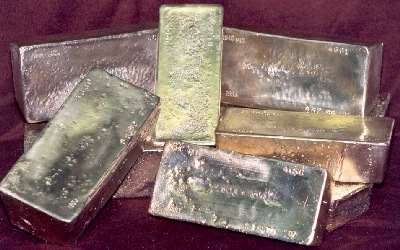
McLaughlin Gold! |
 |
| The "Gold Edition"
CD-ROM wouldn't be complete without some examples of McLaughlin gold! Most
of the gold in the McLaughlin deposit is microscopic, but through the years
that Homestake mined, a number of beautiful gold specimens were found.
Minerals that form in a hot springs-type epithermal system are often very
fine-grained, because a crystal's size is often controlled by the length
of time it has to grow. In a hot springs, cooling happens at a rapid rate,
so crystals are often small. The gold in the McLaughlin deposit is no exception.
With a magnifier and a little familiarity with the deposit, a geologist
could find visible gold in the open pit. But even the geologists had to
look hard to find it!
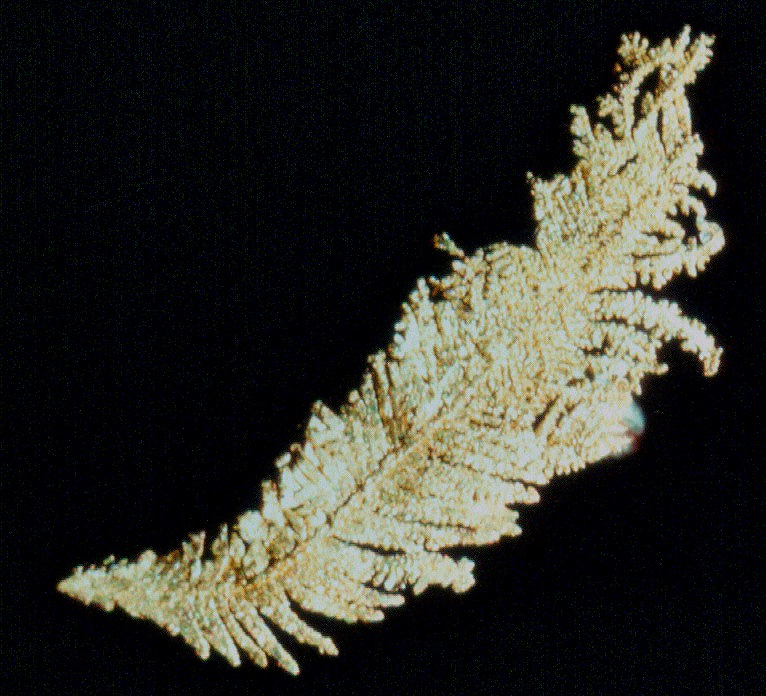
Although the individual gold crystals are usually small, they often branch into tree-like growth patterns, called "dendrites." Dendritic growth is a response to the rapid rate at which the gold crystallized. A dendrite required a nucleus or "seed" crystal to grow from. The "seed" was not necessarily gold. Pyrite, arsenopyrite and other minerals often served as sites for dendrites to commence branching. Silver sulfosalt minerals such as pyrargryrite and myargyrite also frequently accompany gold dendrites. |
|
|
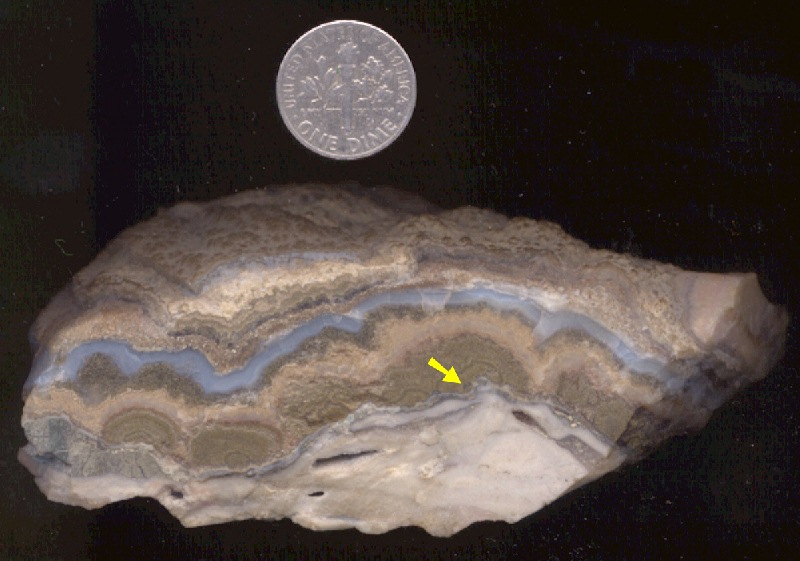
| Gold in the McLaughlin deposit occurs in the form of the natural gold/silver alloy called "electrum." Because of the high silver content, the gold appears grayish-tan in color. The specimen shown below is from the South Pit, near the sheeted vein zone. The arrow points to an arsenopyrite nucleus for one of the dendritic electrum masses. D. Enderlin photo. |
 |
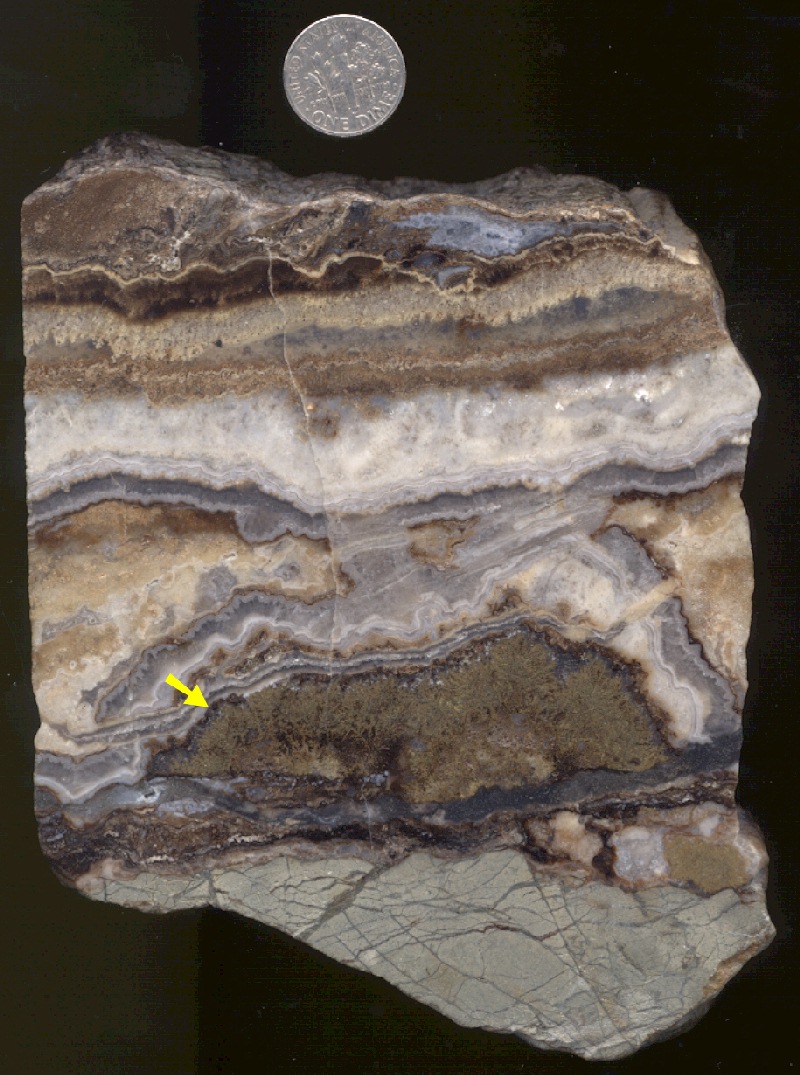
| Below, is another picture of a polished gold-bearing vein from the South Pit. The brown and tan coloration in the quartz/chalcedony bands is due to finely disseminated hydrocarbon residue. In the South Pit, these resiny colors often indicated the presence of higher-grade ore. The arrow points to the outer fringe of a dendritic electrum mass. The fringe is studded by tiny pyrargryrite crystals, which are barely visible in this image. The gray-green wallrock at the bottom of the image is Jurassic metabasalt, referred to as "plagioclase basalt" by Homestake geologists. D. Enderlin scan. |
 |
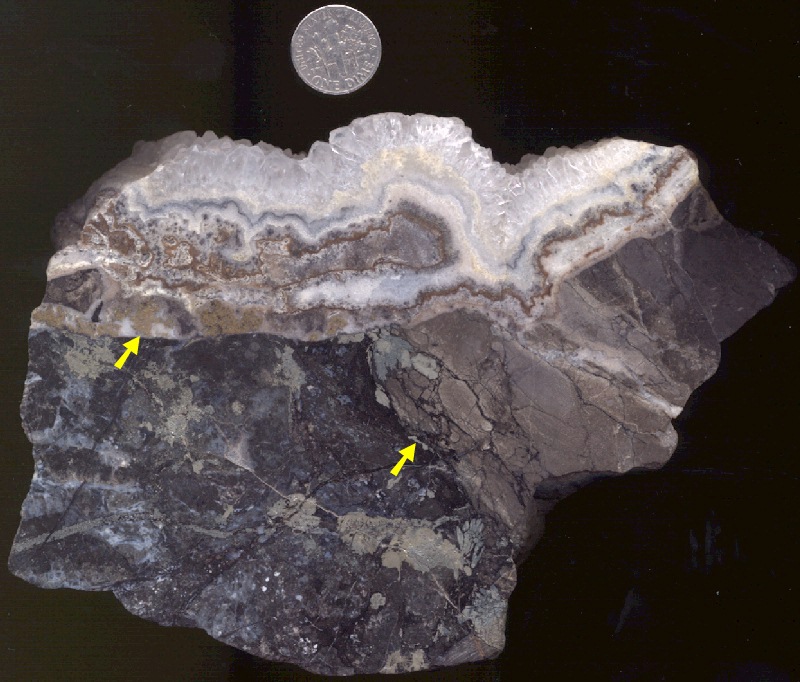
| The spectacular specimen shown below is one of the most significant pieces collected at the mine. This piece came from the North Pit ore zone, which occurred in silicified host rocks in a narrow halo around the Stony Creek Fault. The ore zones tended to be small in the North Pit, but very high grade. The left arrow points to gold dendrites in a quartz-chalcedony vein, while the right arrow points to the actual plane of the Stony Creek Fault. The dark blue-gray material at left and below the vein is silica-carbonate rock (opalized serpentine). The gray material at right is adularized Knoxville formation mudstone. The term, "adularized," refers to the silicifying agent in the mudstone. In zones where the mudstone was hardened due to silicification, the responsible mineral was found to be the potassium feldspar, adularia. D. Enderlin scan. |
 |
| Another sample from the North Pit orebody appears below. The host rock is adularized Knoxville formation mudstone. The quartz vein cuts previously formed pyrite seams in the mudstone, and the intersection of the two served as a nucleation site for dendritic gold growth. The arrow identifies the point of intersection. Wallrock interaction was undoubtedly a control on gold precipitation, but only a few other examples showed this so well. D. Enderlin scan. |
 |
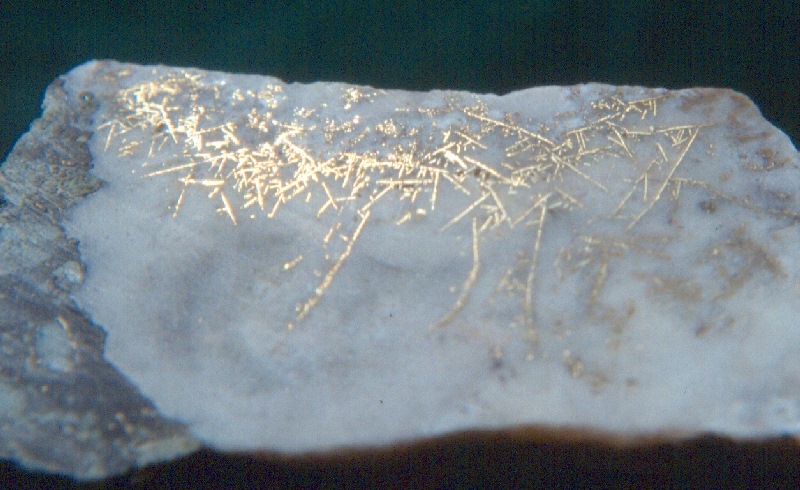
| Below is a specimen showing coarse gold dendrites from the South Pit orebody (not the sheeted vein). The sample is about 10 cm wide. D. Enderlin photo. |
 |
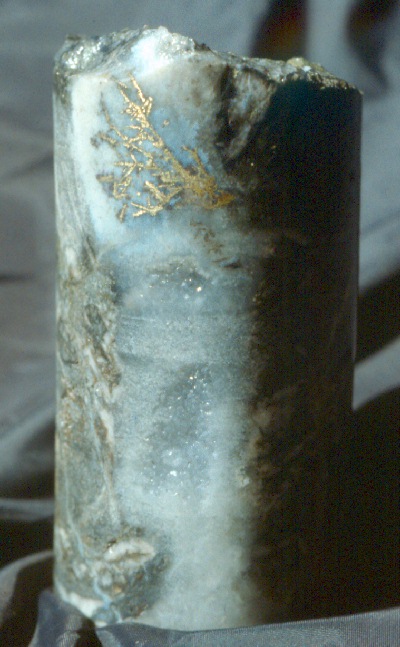
| Below is one of the most beautiful pieces of exploration core to ever come out of the McLaughlin mine. This piece came from an exploration diamond drill hole in the North Pit. The width of the core is about 6.5 cm (HQ size). The sample is displayed at the Homestake corporate headquarters. Ironically, this drill intercept was hundreds of feet below the bottom of the North Pit. The zone was never mined because it was too small and too deep. D. Enderlin photo. |
 |
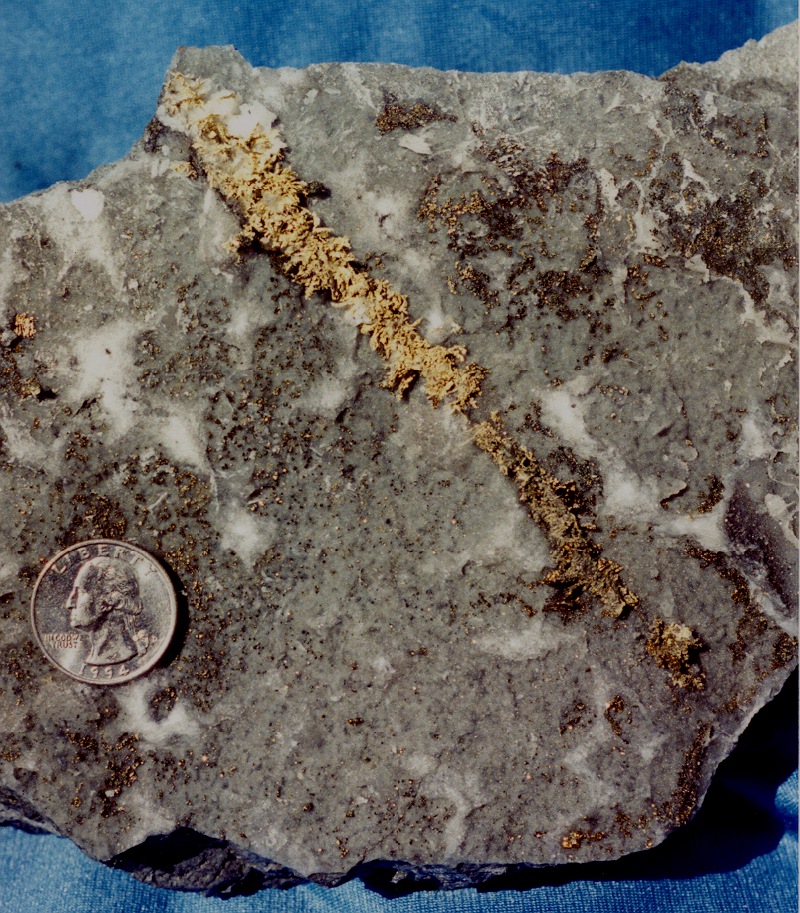
| Another example of gold that was beyond reach is shown below. This sample came from the rib of the Zodiac Drift. The drift was an exploration decline, collared in 1994 from the North Pit and run into the Zodiac Sill (basaltic andesite) to explore a narrow high-grade trend in the hopes of potentially mining it by underground methods. The high-grade was there, but the tonnage wasn't. The zone was rich enough to cause an adjustment in the North Pit open pit mine plan, and some of this material was mined in 1995. The open pit never reached the pocket where this seam was found. D. Enderlin photo. |
 |
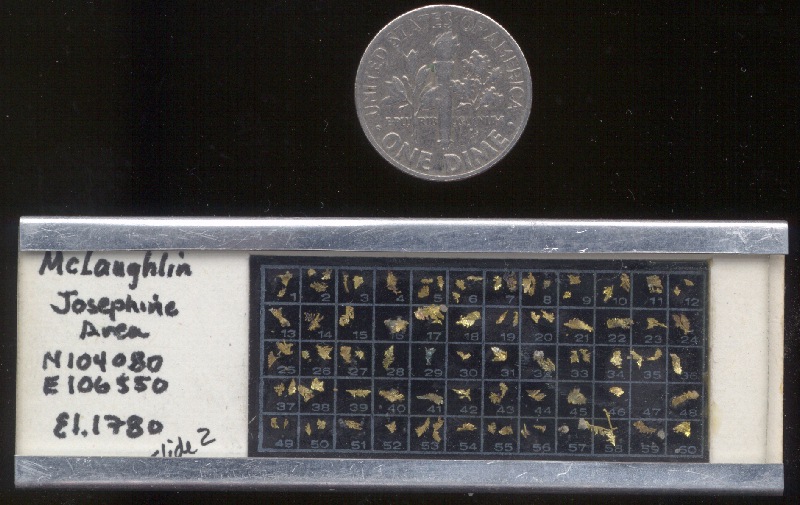
| The gold micromount collection shown below was collected by N. Lehrman, P. Schwarzer and D. Enderlin. The dendrites were found in a single vein where the carbonate gangue had leached away, freeing the gold. For the McLaughlin deposit, this is about as coarse as the gold ever gets! The specimens were collected from the 1780 (MSL) bench of the South Pit, in an area known as Josephine Hill. D. Enderlin scan. |
 |
| Below is a highly magnified view of one of the above dendrites, showing the beauty and complexity of the dendritic gold. N. Lehrman photo. |
 |